How to Ask Your Professor for a Deadline Extension (And Actually Get One)
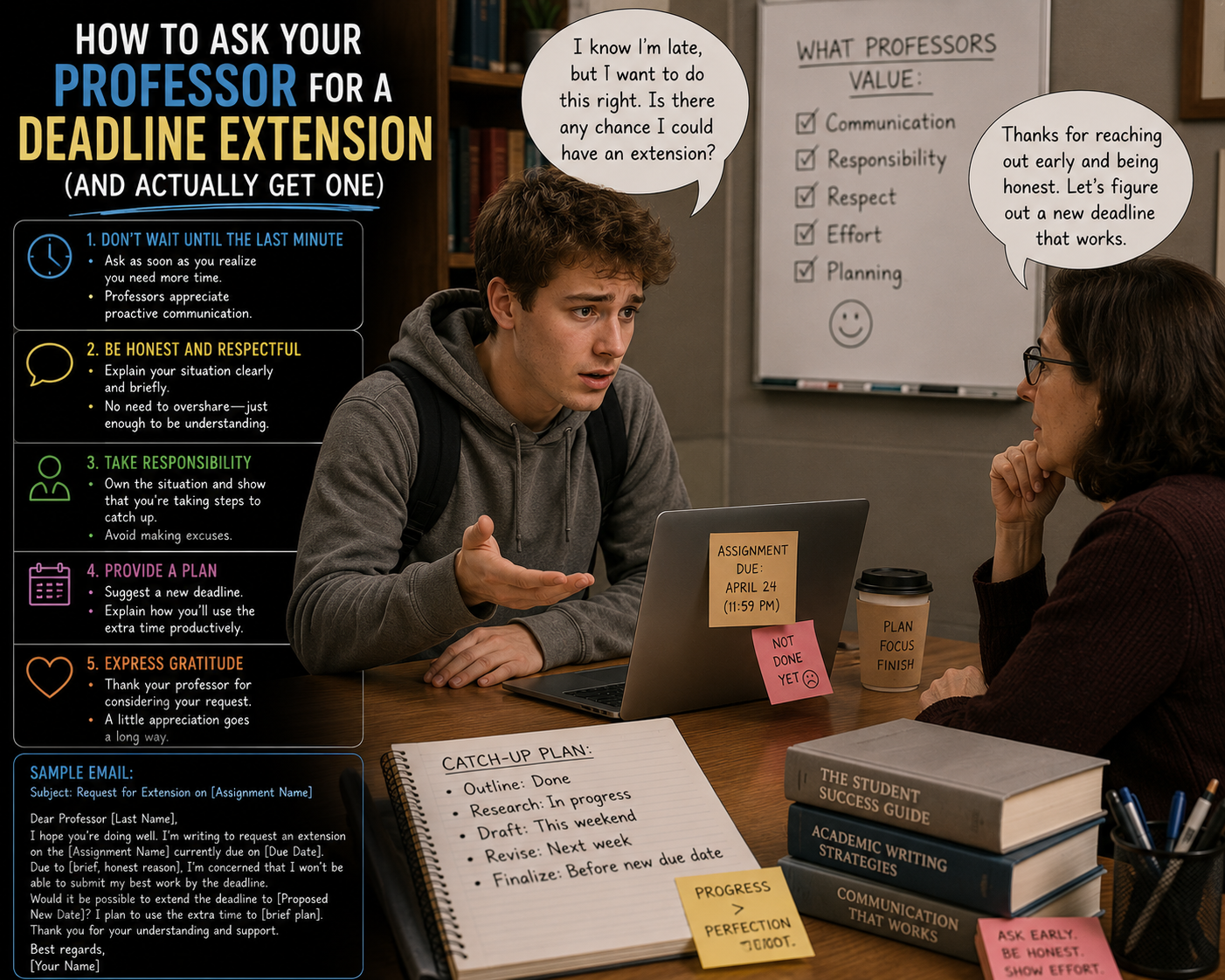
Most students ask for extensions wrong — and get rejected. Here's exactly how to frame the request, what to say, what not to say, and the email templates that actually work.
They wait too long. They apologize too much. They over-explain. They give reasons the professor has heard three hundred times that semester. And then they're surprised when the answer is no.
Getting an extension isn't about luck or how nice your professor is. It's about timing, framing, and showing respect for the professor's time. Here's how to do it right.
The Most Important Rule: Ask Earlier Than You Think You Need To
The biggest mistake students make is waiting until they're desperate. They think asking early makes them look unprepared. It doesn't. It makes them look like they're managing their workload — which is exactly what professors want to see.
A request sent three days before the deadline is a planning problem you're getting ahead of. A request sent at 11pm the night before is a crisis you're now dumping on someone else.
If you know on Tuesday that Friday's deadline is going to be tight, send the email Wednesday morning. Not Thursday night. Wednesday morning.
This one change — just asking sooner — probably doubles your success rate. Professors have more flexibility early in the week than on the day of submission. They can say yes to "I'd like an extension" a lot more easily than "I haven't started yet and it's due in four hours."
What Professors Are Actually Looking At When They Read Your Email
When your professor reads an extension request, here's what they're thinking:
- Is this student communicating professionally or panicking? Panic emails get no. Professional emails get consideration. - Do I believe this reason? Not "is this true" — professors can't verify most reasons. But does it sound plausible and specific? - Has this student shown any engagement with the course? A student who attends, asks questions, and participates gets more benefit of the doubt than one who's invisible. - How much of an inconvenience is this for me? If they have to grade in batches, a late submission creates extra work. If they grade on a rolling basis, it doesn't matter. - What's this student asking for exactly? An open-ended "more time" is harder to say yes to than "48 more hours."
That last one is important. Be specific about what you're asking for. "Could I have until Monday evening?" is a better ask than "Is there any way I could have some extra time?"
What to Include — and What to Leave Out
Include: - A clear, specific reason (one reason — not five) - A specific new deadline you're requesting - Evidence you've already started or are working on it - Any mitigating circumstances that are real and relevant
Leave out: - Excessive apologies ("I'm so sorry, I know this is really bad, I feel terrible...") - Guilt-tripping yourself ("I'm usually such a good student...") - Comparisons to other students ("I heard someone else got an extension...") - Oversharing ("My roommate drama has been insane...") - Last-minute dramatic detail dumps
One genuine reason, stated plainly, is always more believable than a complicated story with a lot of moving parts.
The Email Template
Here's a framework that works. Adapt it — don't copy it verbatim, because professors can tell when they're reading a template.
---
Subject: [Course Code] — Extension Request for [Assignment Name]
Hi Professor [Name],
I'm writing to ask whether I could have an extension on [assignment name], due [original date]. I've been working on it, but [one clear, honest reason — an illness, a family situation, overlapping deadlines from another course, a source access problem you couldn't resolve in time].
I'm wondering if I could submit by [specific date and time]. I want to make sure I hand in work that actually reflects what I've learned in this course, and I think that extra time would make a real difference.
Please let me know if that works — I'm happy to discuss it if you'd like to chat.
Thank you, [Your name] [Course name / section]
---
A few things to notice about that template:
It doesn't start with "I" (which reads as abrupt). It states the problem after already demonstrating you're working on it. It asks for something specific. It ends with an easy out for the professor — "I'm happy to discuss it" signals you're not demanding anything.
When the Answer Is No
Sometimes you'll do everything right and the answer is still no.
If that happens, ask what partial credit looks like for late submissions. A 10% penalty is very different from a zero, and many professors would rather grade a late, complete paper than a rushed incomplete one. It's worth asking.
If the no is firm and the reason is significant — serious illness, a family emergency, something documented — escalate through the proper channels. Most universities have a dean of students office that handles hardship situations. This isn't going over your professor's head — it's using the system the way it was designed.
If You've Already Missed the Deadline Without Asking
This situation is harder, but not hopeless.
Don't pretend it didn't happen. Don't wait another day before emailing. Send a message as soon as you realize you've missed it — even if that's hours after the deadline.
Acknowledge it directly. Say you missed the deadline, you understand if there's a penalty, and ask whether a late submission is still possible. Don't explain why at length — just ask if you can still submit.
Professors see this situation constantly. A student who owns it honestly is in a much better position than one who goes quiet and hopes it resolves itself.
The Real Question
Here's what's underneath all of this: you have work that needs to get done, and not enough time to do it well.
Sometimes an extension solves that. Sometimes the timeline is genuinely immovable — a hard deadline, an end of term, a graded presentation. And sometimes the gap between what you have and what you need to submit is bigger than an extra 48 hours will fix.
If you're in that last situation — facing real work that needs to be genuinely good and you don't have the capacity to get there — that's when professional writing help makes sense. Emergency writing services exist for exactly this reason: not to replace your thinking, but to get you through a deadline that would otherwise break you.
However you handle it: ask earlier next time. That single habit change removes more academic stress than anything else I can think of.
WriteProf Team
WriteProf expert contributor sharing insights on professional writing, career growth, and platform updates.