Academic Integrity in the AI Age: What the Rules Actually Say (and What They Don't)
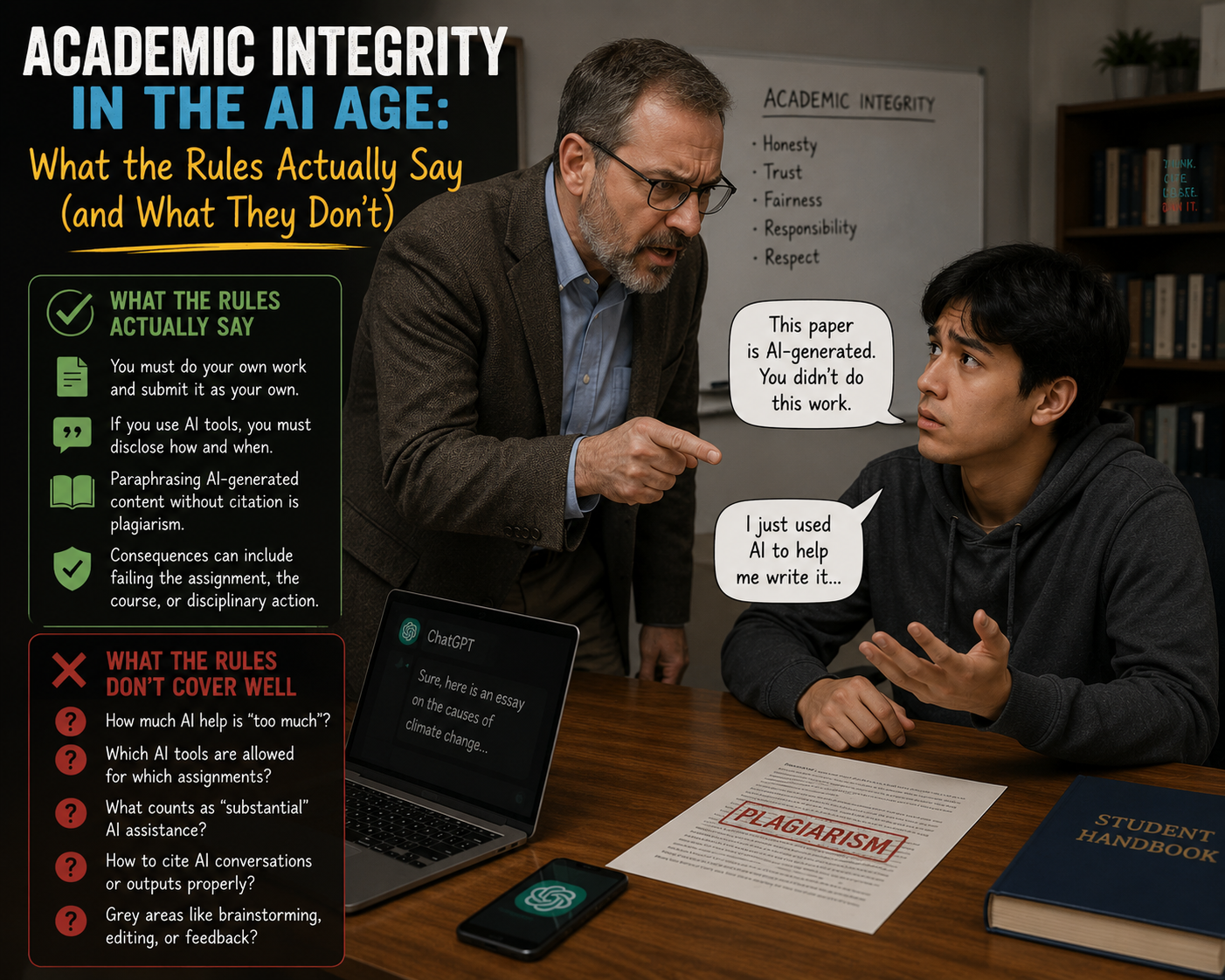
AI policy in universities is a mess right now — inconsistent, unclear, and changing fast. Here's how to navigate it without accidentally crossing a line you didn't know existed.
This has created a situation where students are genuinely uncertain what's allowed — and that uncertainty is risky, because the consequences of getting it wrong are serious.
Here's a realistic overview of the landscape, what different policies actually mean in practice, and how to protect yourself.
Why There Is No Consistent Policy
The honest answer is that universities have been caught flat-footed. ChatGPT became genuinely useful to most people in late 2022. Academic integrity policies move at the speed of committee review, board approval, and curriculum cycles — which is to say, slowly.
Many institutions updated their academic honesty policies in 2023 or 2024, but those updates range from "AI-assisted work must be disclosed" to "any AI use is a violation" to "AI tools are permitted for editing and research but not content generation." Translating those distinctions into actual practice is something professors and departments are still working out.
At the same time, AI tools have genuinely changed what writing assistance means. A student using Grammarly — which has existed for over a decade and was always permitted — is using AI to check their grammar. A student using ChatGPT to draft a paragraph is also using AI, but in a completely different way. The policies are trying to draw a line in territory that wasn't mapped.
The Spectrum of AI Use
It helps to think about AI use in academic writing on a spectrum:
Clearly permitted in most contexts: - Using AI spelling and grammar checkers (Grammarly, Word's built-in tools) - Using AI search tools to find sources (Semantic Scholar, Elicit) - Using AI to understand a concept you're confused about (like asking ChatGPT to explain a statistical method)
Context-dependent — check your specific course policy: - Using AI to generate an outline that you then write from - Using AI to suggest how to rephrase a passage for clarity - Using AI to check whether your argument is logically consistent
Almost universally prohibited when undisclosed: - Submitting AI-generated text as your own writing - Using AI to answer exam questions or write test responses - Using AI for work that's specifically assessing your individual skill
The grey zone is large. That grey zone is where most of the anxiety is.
How to Find Out What's Actually Allowed
The definitive answer is always in your specific course materials. In order of authority:
1. The assignment instructions. If the assignment says "all work must be entirely your own," that's the rule. 2. The course syllabus. Many professors now include an explicit AI policy. 3. The department or faculty AI policy. Often available on the institution's website — more binding than individual professor preferences. 4. The institution's academic integrity code. The baseline that applies to everything when nothing more specific exists.
If after reading those you're still not sure, ask. Email your professor directly: "The assignment asks us to analyze X. I want to confirm — are AI writing tools permitted for any part of this, or should I avoid them entirely?"
That email creates a record of you seeking clarification, which protects you if there's ever a question about your work.
The Disclosure Question
A growing number of policies require disclosure rather than prohibition. "You may use AI tools, but you must disclose how."
What does proper disclosure look like? Some institutions have developed standard statements for course submissions. In the absence of guidance, something like this covers the bases:
"I used [specific tool] during the preparation of this work to [specific purpose — check grammar / suggest structural improvements / generate an initial outline that I then substantially revised]. The analysis, arguments, and writing are my own."
The specificity matters. "I may have used some AI tools" is not disclosure. "I used ChatGPT to generate an outline, then wrote all the content myself, and used Grammarly to check grammar" is disclosure.
The Things AI Actually Does to Your Writing
Beyond policy, there's a practical argument for being careful about how much you rely on AI: it tends to make your writing worse.
AI writing tools optimize for generic acceptability — text that reads as smooth, clear, and inoffensive to the widest possible audience. Academic writing at the level where it gets good marks has a different quality: it reflects the specific thinking of a specific person about a specific question. It has an argument with edges.
When students use AI to generate passages and then lightly edit, the resulting work usually reads flatter than their natural voice. The ideas are less distinctive. The argument is less interesting.
There's also the accuracy problem. AI tools confidently fabricate citations. They misstate study findings. They present contested claims as settled. A student who submits AI-generated content without verifying it is submitting work that may be factually wrong — and if you don't understand the content well enough to check it, you've created a paper that undermines your credibility in the field.
The Bigger Picture
The reason academic integrity exists isn't to catch people. It's to ensure that your degree actually represents what you know and can do. When you hire a structural engineer or a pharmacist, you're trusting that their credentials mean something real.
That sounds abstract when you're drowning in deadlines. But it becomes very concrete when you're in a graduate seminar and you're asked to extend the ideas from your undergraduate thesis — and you don't actually know what's in it because you didn't write it.
There are legitimate ways to get writing help: writing centres, tutors, professional editors, and services that provide genuine human writing support for students who are overwhelmed by the logistics of time pressure. Those options exist because the difficulty is real.
But they work best when you stay engaged with the content — when the help is filling a gap in time or skill, not a gap in your understanding of the subject.
WriteProf Team
WriteProf expert contributor sharing insights on professional writing, career growth, and platform updates.