Turnitin Flagged My Work as AI — And I Wrote Every Word Myself
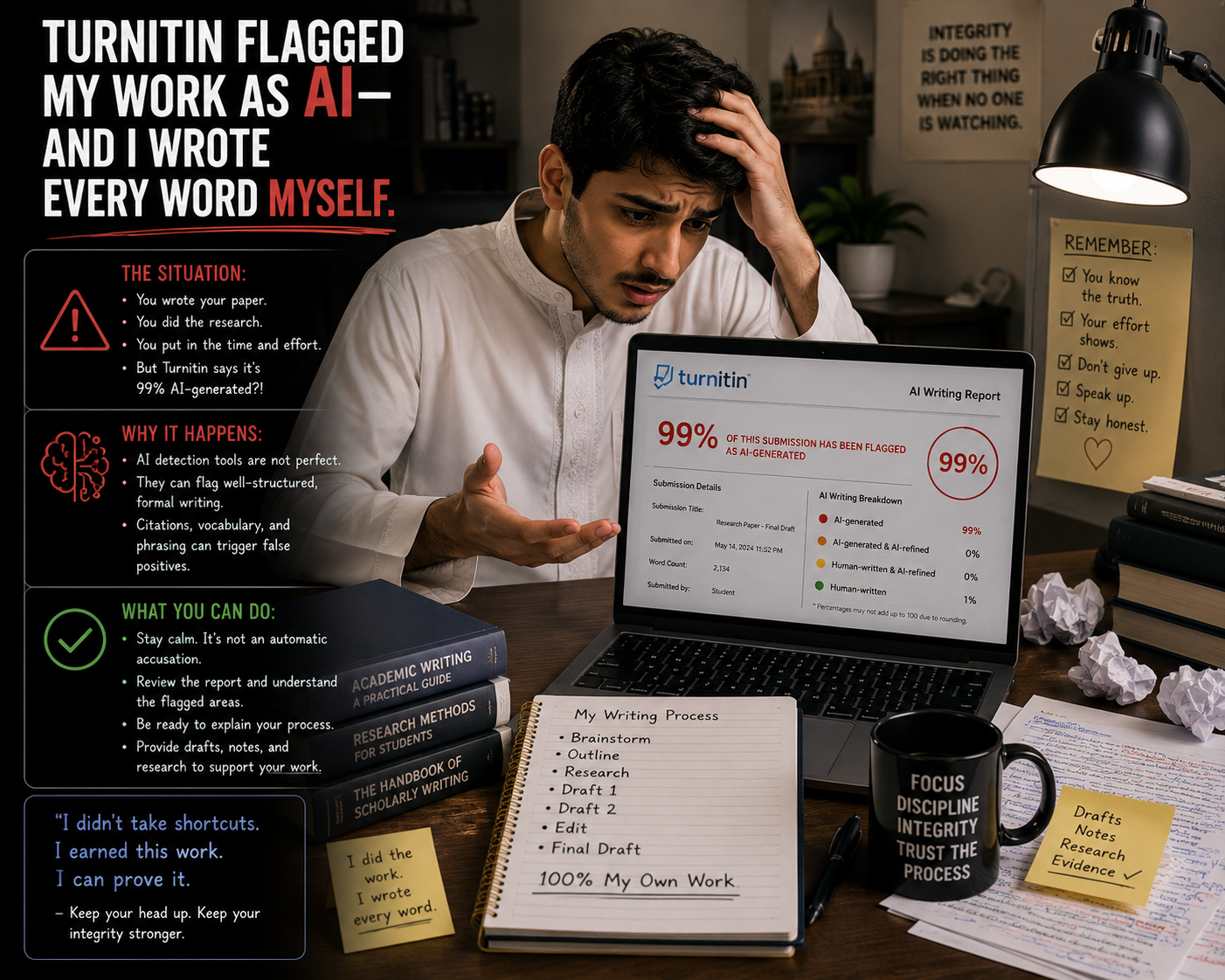
Turnitin's AI detector is calling students cheaters for work they genuinely wrote. Here's what's actually happening inside the tool, who it flags the most, and what to do if it happens to you.
Not students who cheated. Students who sat down, did the reading, and wrote their own work. Then Turnitin's AI detector flagged them at 30%, 40%, sometimes 70% — and suddenly they're defending themselves.
This isn't a rare edge case. Threads about it appear on r/college, r/AskAcademia, and r/GradSchool every single week. "Turnitin says I'm AI. I swear I wrote it." And the responses from other students? Almost always: "Same happened to me."
So what's actually going on?
How Turnitin's AI Detector Works (and Why It Gets It Wrong)
Turnitin's tool — launched in 2023 — doesn't read your paper the way a human does. It analyzes something called "perplexity" and "burstiness."
Perplexity measures how predictable the text is. AI tends to write in highly predictable patterns: smooth transitions, consistent sentence structures, tidy paragraph shapes. Human writing is messier. We wander, repeat ourselves, use an odd word, then overcorrect.
Burstiness measures variety in sentence length. Humans naturally mix very short punchy sentences with longer, more complex ones. AI tends to flatten that — every sentence feels like roughly the same weight.
The problem? Those same "AI-like" patterns show up in a lot of human writing:
- ESL students writing carefully and formally to avoid mistakes - Students who proofread obsessively and cleaned out all their natural roughness - Technical and scientific writing that requires precise, predictable structure - Students who studied writing intensely and learned to write clearly
A 2023 study from Stanford found that AI detectors falsely flagged over 50% of essays written by non-native English speakers as AI-generated. Fifty percent. That's not a bug being fixed — that's a built-in flaw in how these tools work.
What the Percentage Actually Means
When Turnitin shows "23% AI-generated," most people — including some professors — read that as: "23% of this paper was written by ChatGPT."
That's not what it means.
It means 23% of the text segments in your paper match statistical patterns the model associates with AI. Those patterns might be AI. They might also be clear, formal academic writing. The tool genuinely cannot tell the difference with certainty, which is why Turnitin's own documentation says the score is an indicator, not a verdict.
Turnitin has stated their tool has a less than 1% false positive rate at high confidence thresholds. But that 1% covers millions of student papers. And "high confidence" is doing a lot of work in that sentence — lower-confidence flags are far more common, and many institutions treat any AI score as proof.
Who Gets Flagged the Most
Based on documented cases and patterns in academic circles:
International students are the most at-risk group by a significant margin. When English isn't your first language, you write deliberately. You avoid idioms you're not sure about. You use vocabulary you looked up. That careful, formal style reads as "AI" to a detector trained mostly on fluent native-speaker prose.
Students with strong writing training are also frequently flagged. If you've been taught to write with clarity, economy, and structure — if you've eliminated padding and filler — your writing can look statistically clean in the wrong way.
STEM students writing in fields with rigid conventions get caught too. Lab reports, methods sections, and technical descriptions have to be precise and formulaic. That's not AI — that's just how the genre works.
What to Do If You're Flagged
First: don't panic, and don't confess to something you didn't do.
Request the specific segments. Ask your professor or institution which exact passages Turnitin flagged. This matters. If it flagged your methods section because you used standard scientific language, that's a very different situation from flagged narrative sections.
Provide your drafts. If you have version history in Google Docs, show it. If you wrote in Word, the auto-save versions can show the document evolving over days. A paper written by ChatGPT doesn't have a messy draft history — yours does.
Write a process statement. Document your research and writing process. List the sources you consulted. Explain the choices you made. This isn't about proving a negative; it's about demonstrating that a thinking, deciding human was behind the paper.
Request human review. Turnitin's terms of service and most institutional policies require human judgment in any academic integrity case. The AI score alone is not supposed to be sufficient for a finding of misconduct. Push for that review.
Know your appeal rights. Every institution has an academic integrity appeal process. If you're found in violation of something you didn't do, appeal it. Bring your documentation. These processes exist precisely because tools like this aren't infallible.
The Uncomfortable Position Universities Are In
Universities are caught between two fears. On one side: the real and growing problem of students using AI to do work they should be doing themselves. On the other: penalizing students for writing well.
Most faculty didn't sign up to be AI forensic analysts. When Turnitin hands them a number, it feels like an objective answer in a situation where they want certainty.
The result is that the tool has effectively outsourced an ethical judgment — one with serious consequences for students' academic records — to a piece of software that its own creators acknowledge isn't designed to be used as a final arbiter.
The situation is improving slowly. Some institutions have moved to requiring students to submit drafts, outline their research process, or defend their work in conversations with their professor. That's actually a better solution than any detector.
If You're Under Deadline Pressure and Worried About This
One thing worth being honest about: the reason a lot of students end up in this position isn't just the detector. It's that they're working against brutal time pressure, often working on multiple assignments at once, and sometimes not leaving themselves enough time to write in a way that feels authentically theirs.
When you have three days to write something you'd normally need three weeks for, you tend to write in survival mode — cleaner, more mechanical, faster. That's the writing that looks most like AI.
If you're in that position and facing a deadline you genuinely can't meet on your own, getting professional writing support is an option. Writers who do this work full time produce writing that doesn't have AI's statistical fingerprints, because it doesn't — it's written by a person who's done it thousands of times and has a very human style.
But more than that: building in more time, starting earlier, and writing multiple drafts will always produce writing that reads like yours. Because it is.
The tool flags the clean, finished version. It can't flag the messy, real, human process that got you there.
WriteProf Team
WriteProf expert contributor sharing insights on professional writing, career growth, and platform updates.