Academic Writing Services: An Honest Guide to What's Worth Using in 2025
Most reviews of writing services are fake. This one isn't. Here's how to evaluate services honestly, what features actually matter, and what warning signs to avoid.
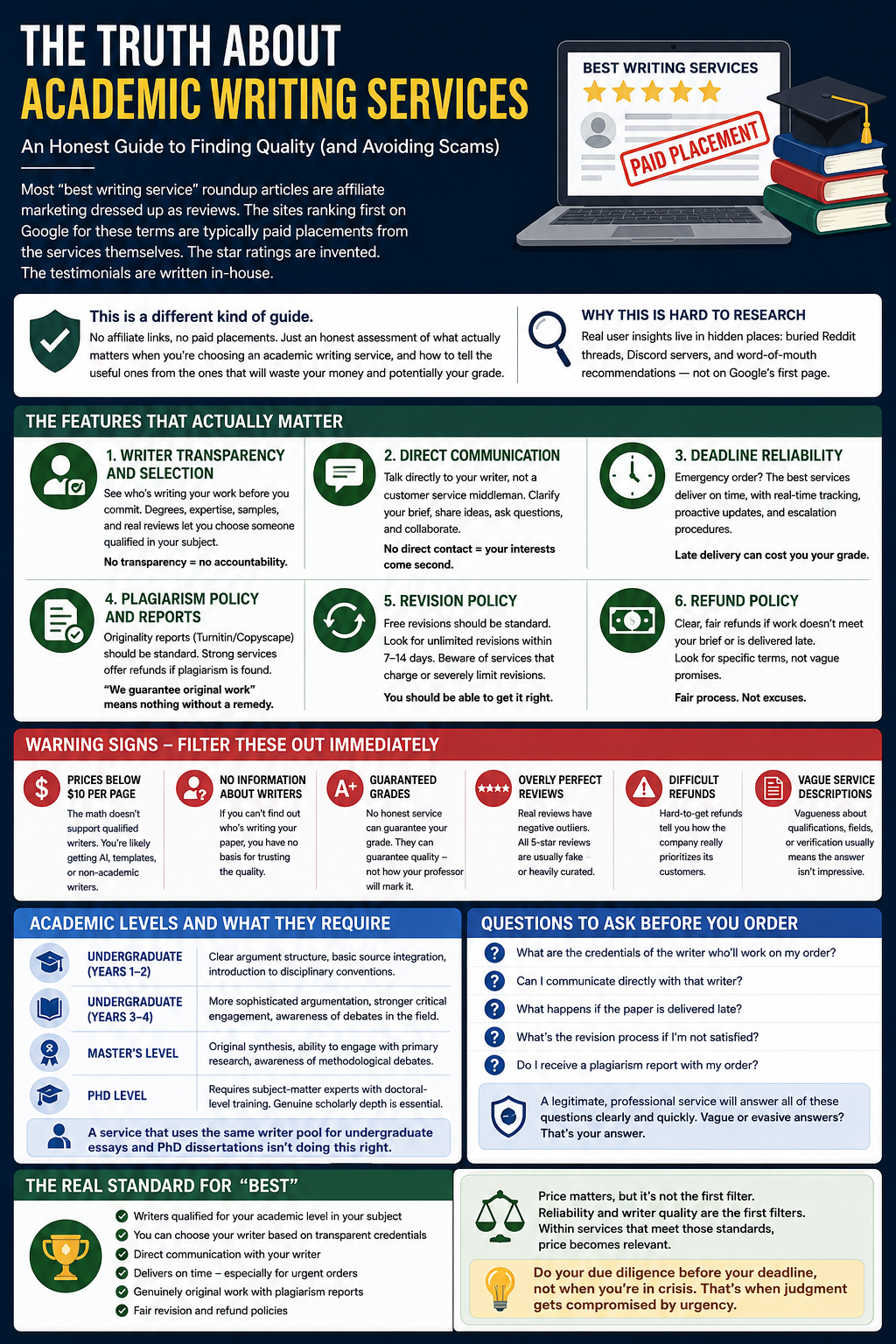
This is a different kind of guide. No affiliate links, no paid placements. Just an honest assessment of what actually matters when you're choosing an academic writing service, and how to tell the useful ones from the ones that will waste your money and potentially your grade.
Why This Is Hard to Research
The writing service industry has an unusual information problem: the people most qualified to review these services (students who've used them) are often reluctant to say so publicly, for obvious reasons. This creates a vacuum that gets filled by fake reviews, SEO spam, and affiliate sites posing as independent reviewers.
The result is that if you Google "best essay writing service," you're getting paid advertising, not honest information. The sites ranking at the top are paying to be there or have extensive SEO infrastructure built around these keywords.
Actual useful information tends to live in less visible places: buried Reddit threads, Discord servers for specific universities, direct recommendations from students you know. This guide tries to synthesize what that less-visible conversation actually says.
The Features That Actually Matter
After extensive research into real user experiences — not review sites — these are the factors that consistently separate good experiences from bad ones:
Writer Transparency and Selection
The single strongest predictor of quality is whether you can see who's writing your work before you commit. Not just a username and a star rating — actual information: degree level, area of specialization, writing samples, reviews from previous clients.
Services that keep writers completely anonymous are protecting a system that doesn't hold individual writers accountable. You end up in a pool being matched algorithmically with whoever is available, regardless of whether they know anything about your topic.
Services with transparent writer profiles let you make an informed choice. You can see that the writer you're selecting has a PhD in the relevant field, has worked on similar papers, and has a track record of satisfied clients in your subject area.
Direct Communication
You need to be able to talk to the writer. Not a customer service intermediary who relays messages — the actual writer.
This matters for several reasons: you can clarify your brief, share your own ideas and sources, get early reassurance that the approach is right, and ask questions about the subject matter. This collaborative element is what makes the difference between a piece that sounds like a generic paper and one that reflects your thinking.
Services that forbid direct writer-client contact are usually doing it for business reasons (prevents writers from going off-platform) that conflict with your interests as a buyer.
Deadline Reliability
Especially for emergency orders, this is non-negotiable. A service that promises 6-hour turnaround and delivers in 8 hours hasn't just inconvenienced you — they've potentially cost you your grade.
The best services have real-time tracking, send proactive updates when work is in progress, and have internal escalation procedures when a deadline is at risk. Some offer compensation if delivery is late.
Look specifically for user reviews that mention deadline adherence, not just content quality. The two are separate things and a service can be good at one while being unreliable on the other.
Plagiarism Policy and Reports
Every piece of work should come with an originality report as standard — not as an add-on. Turnitin reports are the most recognizable, but third-party tools like Copyscape also work.
Some services offer guarantees: if plagiarism is found, you get a full refund. This is meaningful. "We guarantee original work" without a defined remedy is not meaningful.
Revision Policy
Free revisions should be standard and clearly defined. You want to know: how many revisions are included? How long do you have to request them? What qualifies as a revision versus a new order?
The best policies offer unlimited revisions within a reasonable window (7–14 days for most orders). Be cautious of services that charge for revisions or limit them to a very small number.
Refund Policy
A legitimate service should offer refunds if the delivered work genuinely doesn't meet the specifications of your brief. Not "we decide whether it meets specifications" — a fair external standard.
Look for specifics: full refund if the paper is late, full or partial refund if the quality doesn't match the claimed academic level, process for dispute resolution if you and the writer disagree.
Warning Signs to Filter Out Immediately
Prices below $10 per page for any service. The math simply doesn't support qualified human writers at this rate. What you're buying at this price point is almost certainly AI output, heavily templated work, or writing from non-academic writers.
No information about writers. If you can't find out who's writing your paper, you have no basis for trusting the quality.
Guaranteed grades. No honest writing service can guarantee your grade. A service that claims otherwise is lying or has misunderstood how grades work. They can guarantee the quality and originality of the work — they cannot guarantee how your professor will mark it.
Overly perfect reviews. Real customer reviews have negative outliers. Services where every single review is 5 stars and glowing are almost certainly curating or fabricating reviews.
Difficult cancellation or refund processes. If getting a refund requires jumping through multiple hoops, talking to multiple customer service agents, or waiting weeks — this tells you something about how the company prioritizes customers.
Vague service descriptions. "We have expert writers in all fields." How many fields? What are their qualifications? How do they verify expertise? Vagueness at this level usually means the answer isn't impressive.
Academic Levels and What They Require
One thing many services don't explain clearly: academic level matters a lot, and the writer needs to be matched to it.
Undergraduate (Years 1–2): Clear argument structure, basic source integration, introduction to disciplinary conventions. Most competent academic writers can handle this.
Undergraduate (Years 3–4): More sophisticated argumentation, stronger critical engagement with sources, awareness of debates within the field. Requires a writer with genuine subject knowledge.
Master's level: Original synthesis, ability to engage with primary research, awareness of methodological debates. Requires writers with postgraduate credentials in the relevant field.
PhD level (coursework, proposals, dissertation chapters): At this level, you need a writer who is themselves a subject-matter expert with doctoral-level training. The writing requires genuine scholarly depth that can't be faked.
A service that uses the same writer pool for undergraduate essays and PhD dissertations isn't doing this right.
Questions to Ask Before You Order
Before placing any order, ask the service directly:
- What are the credentials of the writer who'll work on my order? - Can I communicate directly with that writer? - What happens if the paper is delivered late? - What's the revision process if I'm not satisfied? - Do I receive a plagiarism report with my order?
A legitimate, professional service will answer all of these questions clearly and quickly. Vague, evasive, or boilerplate answers tell you something.
The Real Standard for "Best"
The best academic writing service for your needs is the one that:
Has writers qualified to work at your academic level in your specific subject area. Lets you choose your writer based on transparent credentials. Allows direct communication. Delivers on time — especially on emergency timelines. Produces genuinely original work. Offers fair revision and refund policies.
Price matters, but it's not the first filter. Reliability and writer quality are the first filters. Within services that meet those standards, price becomes relevant.
Do your due diligence before your deadline, not when you're in crisis — that's when judgment gets compromised by urgency.
WriteProf Editorial Team
WriteProf expert contributor sharing insights on professional writing, career growth, and platform updates.