How to Write a Strong Thesis Statement (With Examples)
A weak thesis is the most common reason good essays fail. Learn the exact formula for writing a thesis statement that's specific, arguable, and guides your whole paper.
This guide shows you exactly how to write a strong thesis statement — with real examples across different essay types.
What a Thesis Statement Is (and Isn't)
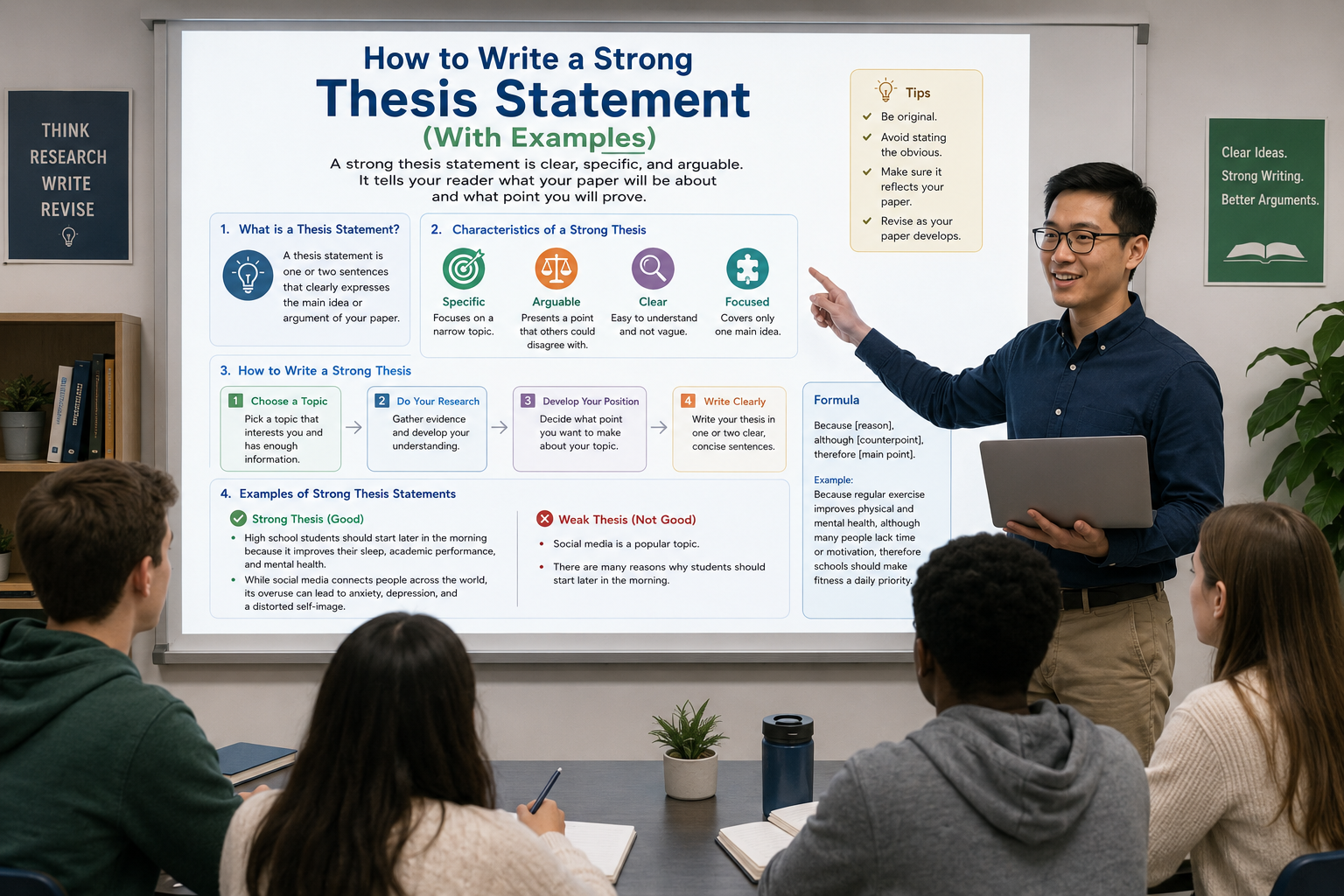
A thesis statement is a specific, arguable claim that your essay will prove.
It is NOT: - A question ("What causes climate change?") - A statement of fact ("Climate change is real") - A vague generalisation ("Social media has pros and cons") - An announcement ("In this essay, I will discuss...")
It IS: - A position you can defend with evidence - Specific enough to be meaningful - Broad enough to require a full essay to support
The Formula
[Specific topic] + [Your position/claim] + [Main reasons or "because" clause]
> "Remote work increases employee productivity because it eliminates commute fatigue, allows for personalised work environments, and reduces unnecessary meetings."
That's a thesis. It's specific, it's arguable (someone could disagree), and it tells you exactly what the three body paragraphs will cover.
Examples by Essay Type
Argumentative Essay
Weak: "Social media is bad for teenagers." Strong: "Instagram and TikTok contribute to measurable declines in adolescent mental health by promoting unrealistic beauty standards, enabling cyberbullying, and displacing time spent on in-person social connection."
Analytical Essay
Weak: "The Great Gatsby is about the American Dream." Strong: "In The Great Gatsby, Fitzgerald uses Gatsby's doomed pursuit of Daisy to argue that the American Dream is fundamentally corrupted by class inequality — a dream that promises upward mobility while actually reinforcing social boundaries."
Compare and Contrast Essay
Weak: "APA and MLA are two different citation styles." Strong: "While both APA and MLA organise academic sources, APA's emphasis on publication dates reflects the sciences' prioritisation of recency, whereas MLA's focus on authorship reflects the humanities' concern with textual interpretation."
Cause and Effect Essay
Weak: "Fast food causes health problems." Strong: "The proliferation of fast food restaurants in low-income neighbourhoods is a leading driver of diet-related disease in those communities, driven by food deserts, aggressive marketing, and pricing that makes unhealthy food the most accessible option."
Research Paper
Weak: "This paper examines the effects of sleep deprivation on academic performance." Strong: "Chronic sleep deprivation among university students significantly impairs cognitive function, memory consolidation, and emotional regulation, with cascading effects on GPA and long-term academic outcomes."
The Three Tests
Before you finalise your thesis, run it through these three tests:
1. The "So what?" test Why does your claim matter? If you can't answer that in one sentence, the thesis isn't strong enough.
2. The "Could someone disagree?" test If your thesis is a fact or a definition, no one can disagree — which means there's nothing to argue. A good thesis is contestable.
3. The "Does my evidence prove this?" test Look at your evidence. Does it actually support your thesis, or is there a gap? If the evidence doesn't match, revise the thesis, not the evidence.
How to Revise a Weak Thesis
Start with a question: "Does social media affect mental health?"
Turn it into a claim: "Social media negatively affects mental health."
Add specificity: "Heavy social media use negatively affects the mental health of adolescents."
Add your reasons: "Heavy social media use negatively affects adolescent mental health by increasing social comparison, disrupting sleep patterns, and reducing the quality of face-to-face relationships."
That final version is a publishable thesis statement.
Where the Thesis Goes
In most academic essays, the thesis appears at the end of the introduction — the last one or two sentences. In longer research papers, it may appear after a brief literature review section.
Never bury your thesis in the middle of the introduction or the body of the essay. Readers need to know your claim before they read your evidence.
Need a Professionally Written Essay?
If you're working against a tight deadline and need an essay with a strong, focused argument from the start, WriteProf's vetted professional writers can help — from 1 hour onwards.
[Place your order now →](https://writeprof.com/signup)
WriteProf Team
WriteProf expert contributor sharing insights on professional writing, career growth, and platform updates.