MLA vs APA vs Chicago: Which Citation Style Should You Use?
Confused about which citation style your paper needs? Here's a clear breakdown of MLA, APA, and Chicago — when to use each, how they differ, and quick examples.
The three most common academic citation styles — MLA, APA, and Chicago — each have their own logic, their own rules, and their own frustrating edge cases. Here's exactly what you need to know about all three.
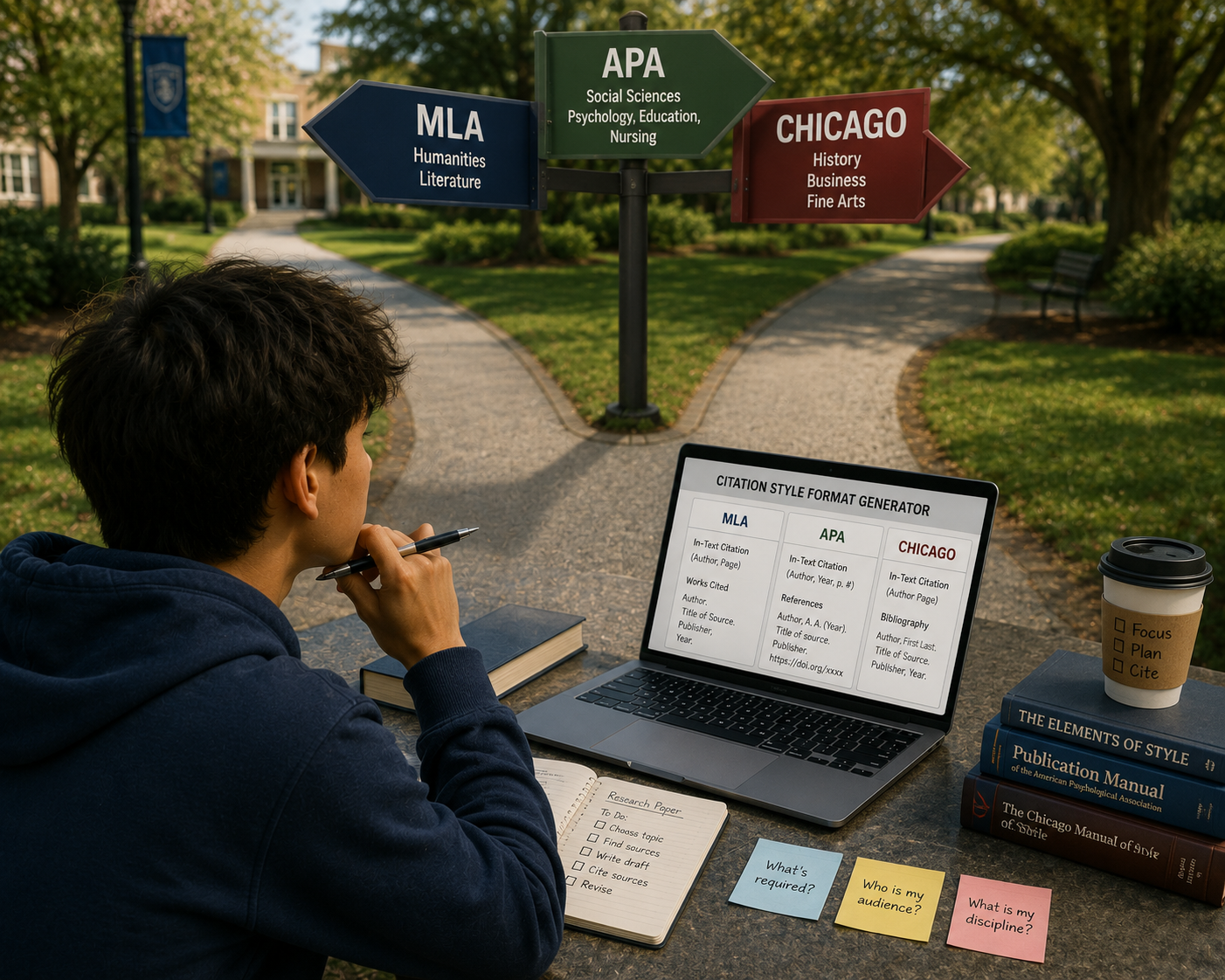
The Short Answer: Which Style for Which Subject?
| Field | Style | |-------|-------| | Literature, Language, Film, Media | MLA | | Psychology, Education, Social Sciences, Nursing | APA | | History, Philosophy, Art, Music | Chicago | | Business | Usually APA | | Sciences | Often APA or discipline-specific | | Law | Bluebook (different guide) |
When in doubt, check your syllabus or ask your professor. Never assume.
MLA (Modern Language Association)
Used in: Humanities — literature, film, language, cultural studies
Core logic: MLA cares most about who wrote it and where to find it in the text. Publication dates are less prominent because in the humanities, a 1950 book can be just as relevant as one from last year.
MLA In-Text Citation
> (Smith 45) > Author's last name + page number. No comma. No "p."MLA Works Cited Entry (Book)
> Smith, John. The Great Argument. Penguin Books, 2020.MLA Works Cited Entry (Journal Article)
> Smith, John. "The Role of Metaphor." Journal of Literary Studies, vol. 12, no. 3, 2021, pp. 45–67.Key MLA Rules
- Title page: not required (author info goes in top-left corner of first page) - "Works Cited" not "Bibliography" or "References" - Hanging indent on all entries - Italicise book and journal titles - No italics on article titles — use quotation marksAPA (American Psychological Association)
Used in: Social sciences, psychology, education, nursing, business
Core logic: APA prioritises when it was published — because in the sciences and social sciences, recency matters. A 2015 study on depression treatments is far less relevant than a 2024 one.
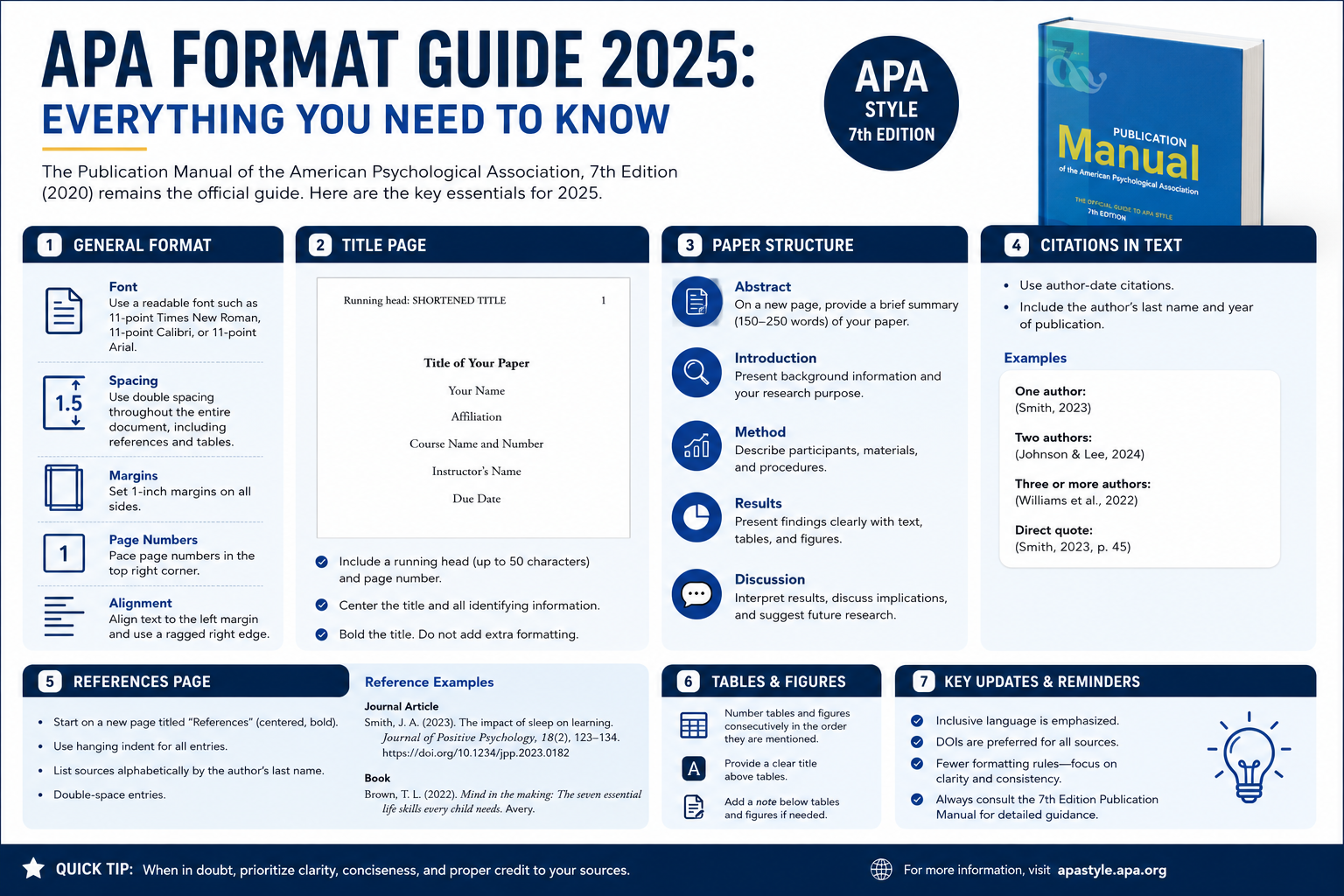
APA In-Text Citation
> (Smith, 2022) > (Smith, 2022, p. 45) — for direct quotesAPA Reference Entry (Journal Article)
> Smith, J. A. (2022). Title of article in sentence case. Journal Name, 12(3), 45–67. https://doi.org/xxxxxAPA Reference Entry (Book)
> Smith, J. A. (2020). Book title in sentence case. Publisher.Key APA Rules
- Current version: 7th edition (published 2020) - Title page required — includes paper title, author, institution, course, instructor, date - "References" not "Works Cited" - Sentence case for article and book titles (only capitalise first word and proper nouns) - Title case for journal names - Include DOI wherever available - et al. for 3+ authors from first mentionChicago Style
Used in: History, philosophy, art history, music, some social sciences
Core logic: Chicago has two systems — Notes-Bibliography (used in humanities) and Author-Date (used in social sciences). Most history papers use Notes-Bibliography.
Chicago Notes-Bibliography (Footnote)
> ¹ John Smith, The Great Argument (London: Penguin Books, 2020), 45.Chicago Notes-Bibliography (Bibliography Entry)
> Smith, John. The Great Argument. London: Penguin Books, 2020.Key Chicago Rules
- Footnotes or endnotes for in-text citations (not parenthetical) - First reference: full citation in footnote - Subsequent references: shortened form (Smith, Great Argument, 45) - Bibliography at the end (full entries, alphabetised) - Publisher and place of publication included (unlike APA)Side-by-Side Comparison
| Feature | MLA | APA | Chicago | |---------|-----|-----|---------| | In-text style | Author + page | Author + year | Footnote | | Date position | End of entry | After author | End of entry | | Title page | No | Yes | Yes | | End list name | Works Cited | References | Bibliography | | Sentence case titles | No | Yes | No |
The Most Common Mistakes
MLA: Putting the date in the wrong place, using "Bibliography" instead of "Works Cited"
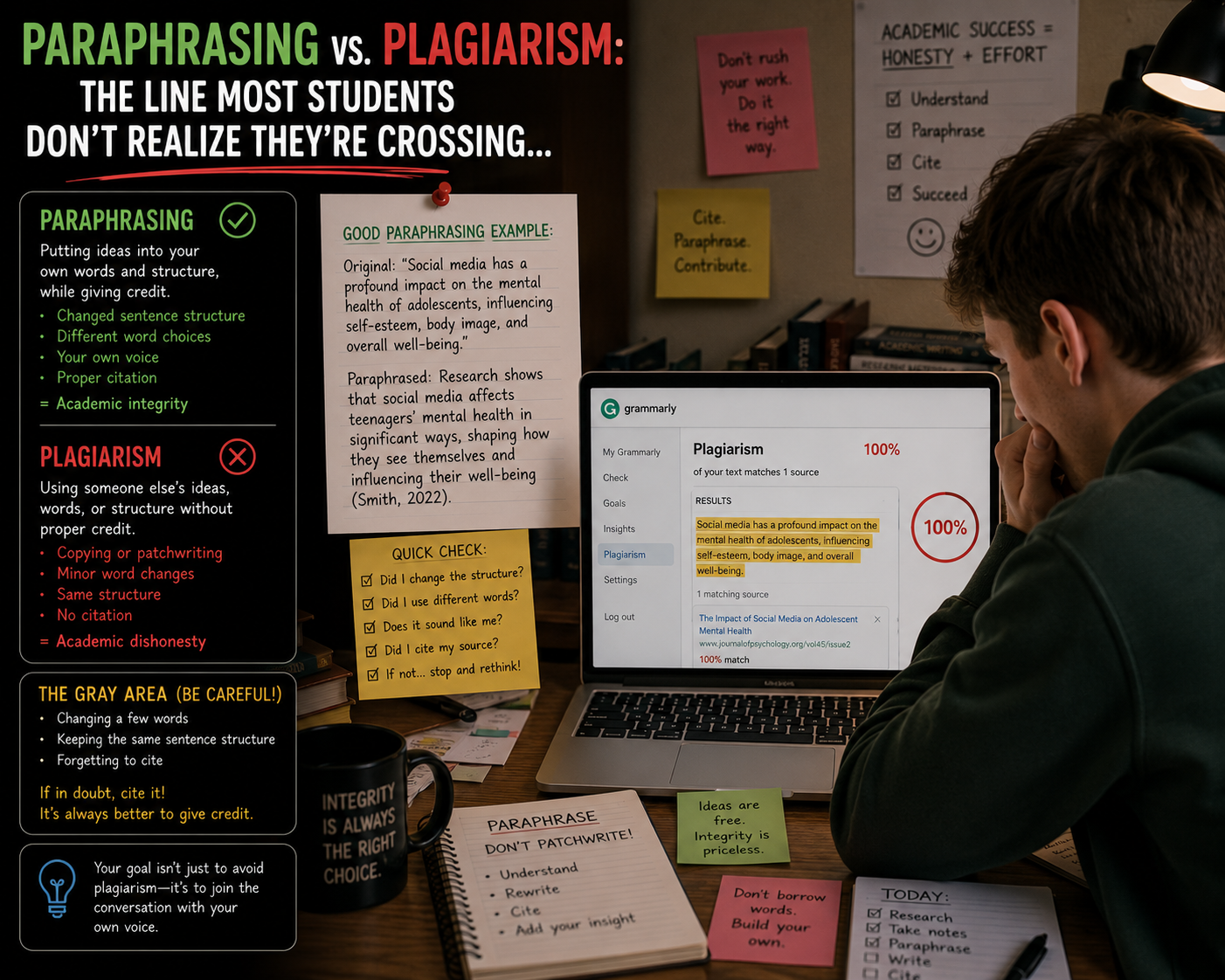
APA: Using title case for article titles (should be sentence case), forgetting DOIs, listing all authors instead of et al.
Chicago: Forgetting to shorten repeated footnotes, confusing Notes-Bibliography with Author-Date system
Need Perfectly Formatted Citations?
Citation formatting is one of the most time-consuming parts of academic writing — and one of the easiest to get wrong. WriteProf's professional writers format every paper correctly in your required citation style.
[Get a properly formatted paper →](https://writeprof.com/signup)
WriteProf Team
WriteProf expert contributor sharing insights on professional writing, career growth, and platform updates.