Paraphrasing vs. Plagiarism: The Line Most Students Don't Realize They're Crossing
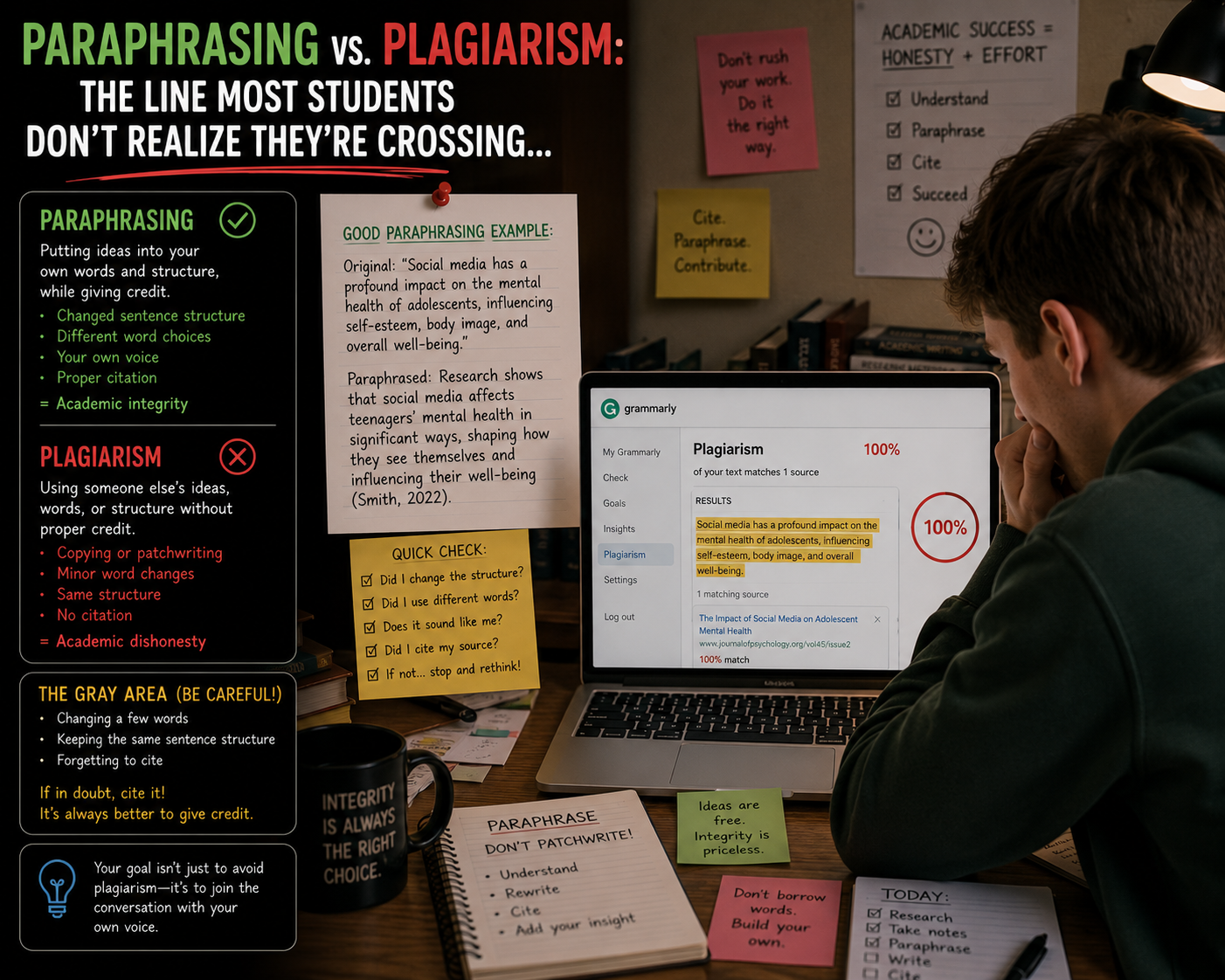
Changing a few words isn't paraphrasing. It's mosaic plagiarism — and it shows up clearly on plagiarism checkers. Here's where the line actually is and how to stay well on the right side of it.
But the form of plagiarism that actually catches people — the one behind most of the academic integrity cases professors deal with — isn't copy-paste. It's something called mosaic plagiarism, and a lot of students committing it genuinely don't know they're doing anything wrong.
What Mosaic Plagiarism Actually Is
Mosaic plagiarism is what happens when you take a source and change just enough words that it doesn't look like a direct quote, but the structure, the ideas, and the phrasing are still fundamentally the author's.
Here's an example. Original text:
"The industrial revolution fundamentally transformed labour markets across Europe, driving mass migration from rural agricultural communities to urban manufacturing centres."
Student "paraphrase":
"The industrial revolution deeply changed labour markets throughout Europe, causing large-scale movement from rural farming communities to urban manufacturing areas."
If you're reading that and thinking "that's basically the same sentence," you're right. Swapping "fundamentally transformed" for "deeply changed" and "mass migration" for "large-scale movement" isn't paraphrasing. It's relabeling.
Even with a citation, this isn't paraphrasing — it's still plagiarism, because you're presenting the author's original sentence construction and logic as your own.
Why Turnitin Catches This (and Sometimes Doesn't)
Plagiarism detection tools have gotten much better at catching mosaic plagiarism, but they still miss a lot of it. The tool flags exact or near-exact phrase matches. It's not assessing whether you understood and processed the idea or just rearranged it.
That means you can submit something that comes back clean on Turnitin and still have plagiarized. Professors who are reading closely — especially in smaller classes and graduate programs — often spot mosaic plagiarism without any software. The tell is that the passage suddenly reads differently from the rest of your paper. The vocabulary shifts. The sentence structure changes. The voice doesn't sound like you anymore.
That's the other irony of mosaic plagiarism: it's self-defeating. The borrowed passage usually sticks out.
What Real Paraphrasing Actually Looks Like
Real paraphrasing involves three things that have nothing to do with word swapping:
1. You fully understand what you read before you write.
Close the source. Actually close it. Then write what you understood from it in your own words. If you need to keep glancing back at the text to write your "paraphrase," you're not paraphrasing — you're transcribing with a thesaurus.
2. The structure of the idea is yours.
The author's original text has a structure: a specific order of ideas, a specific cause-and-effect logic, a specific emphasis. Your paraphrase should reflect your interpretation of that idea, not mirror the author's structure with different words.
3. You still cite.
Paraphrasing doesn't mean the idea becomes yours. You're still using someone else's research or argument. The citation is required whether you quote or paraphrase. A lot of students think paraphrasing removes the need to cite. It doesn't.
Here's what a real paraphrase of that industrial revolution sentence might look like:
"Urban manufacturing centres grew rapidly as Europe industrialised, drawing workers away from farming in numbers that fundamentally reshaped where and how people lived (Author, Year)."
Same historical fact. Completely different structure. The emphasis is on the cities pulling workers in, rather than the revolution pushing people out. That's my interpretation of the causal relationship, expressed in my syntax, with attribution.
The "Common Knowledge" Escape Hatch (and Its Limits)
Students sometimes ask: "But what if everyone knows this? Do I still have to cite it?"
The common knowledge rule is real but narrow. Something is common knowledge if:
- It's widely known across many sources and contexts - It wouldn't be contested by any reasonable person in the field - It's factual, not analytical
"The Earth orbits the Sun" — common knowledge. "The Battle of Hastings was in 1066" — common knowledge. "The industrial revolution began in Britain in the late eighteenth century" — arguable either way; safer to cite.
What is definitely not common knowledge: interpretations, arguments, analysis, statistics, study findings, and expert opinions. Those always need attribution, no matter how often you've heard them repeated.
Self-Plagiarism: The One Nobody Expects
Here's one that surprises a lot of people: submitting your own previous work is also a form of plagiarism in most academic contexts.
If you wrote a section for one course and resubmit it in another — even though you wrote it, even though it's your words — that typically violates academic integrity policies. The point of an assignment is to demonstrate learning done for that course. Recycling past work misrepresents that.
This is especially relevant if you're building on your own previous research. You can reference your prior work — just cite it the same way you'd cite anyone else.
How to Actually Build the Habit
The students who never have plagiarism problems aren't the ones who are most careful about citations — they're the ones who genuinely process their sources before they write.
The workflow is:
Read your sources. Take notes in your own words while you read — not transcribed quotes, but what you understood. Close the sources. Write from your notes. Then go back to the sources and cite anything that isn't your original thought.
It sounds slow. It's actually faster than the alternative, because you spend a lot less time worrying about whether what you wrote is original and a lot more time actually thinking. And the writing tends to be better — because it's actually yours.
If you're working on a paper right now and you're genuinely unsure whether what you've written crosses the line, the safest thing is to go back to those passages and rewrite them from scratch without looking at the source. If you understand the material well enough to do that, you'll be fine.
If you don't understand it well enough to do that yet — that's a separate problem, and probably a sign you need more time with the material than the deadline allows.
WriteProf Team
WriteProf expert contributor sharing insights on professional writing, career growth, and platform updates.