Abstract vs. Introduction: What's Different and How to Write Both
These two sections confuse almost every student writing their first research paper. They're not the same thing. Here's exactly what each one does and how to approach them.
They're not. But they overlap enough that the confusion is completely understandable, especially when you're writing your first few.
Here's the clearest way I know to explain the difference:
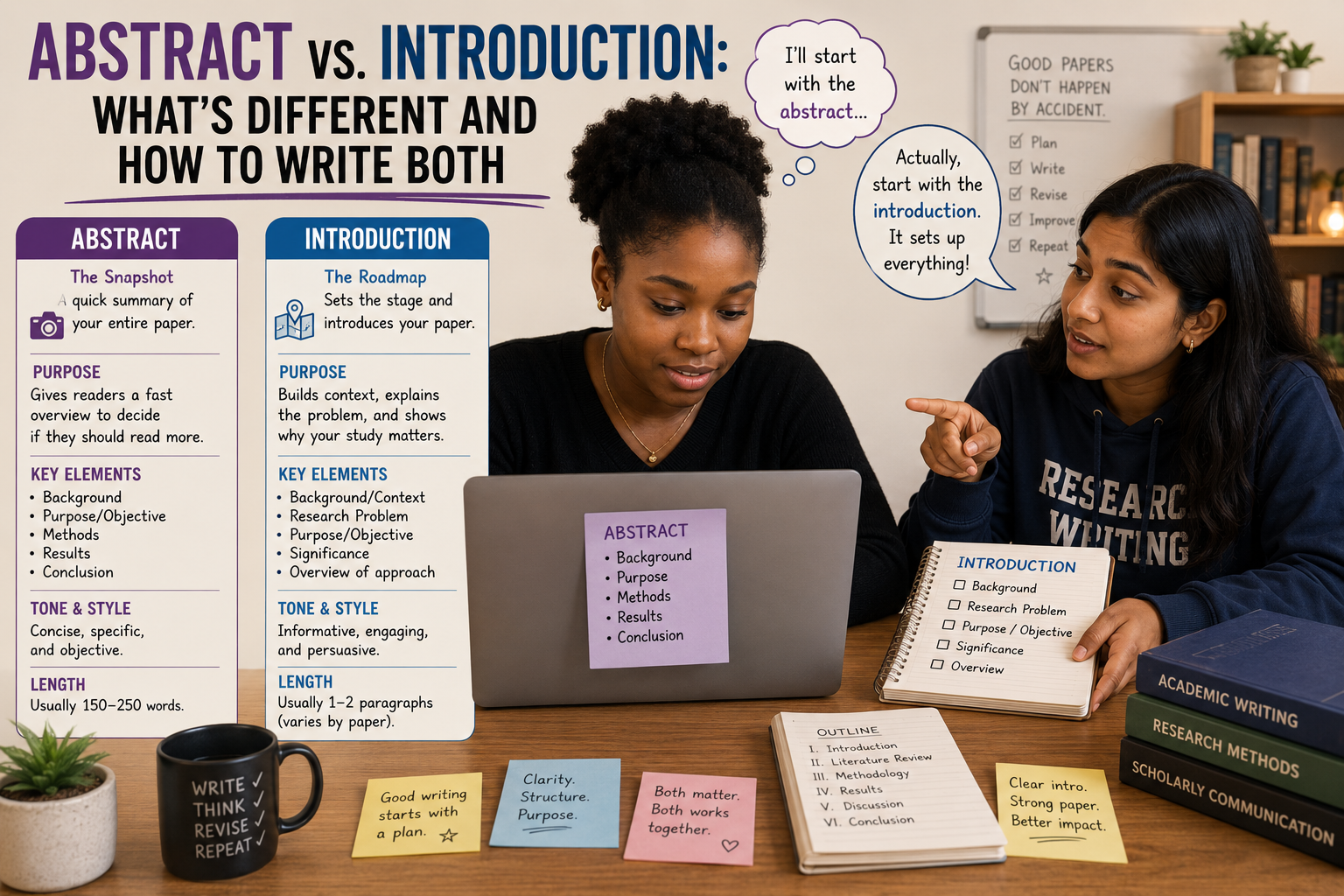
The abstract is for someone who might not read your paper. It gives them enough information to decide whether they want to. A standalone document. Everything the reader needs to understand your study, what you did, and what you found — in 150-300 words.
The introduction is for someone who is reading your paper. It draws them in, establishes the context, and gives them the orientation they need to understand everything that follows.
One serves as a substitute. One serves as an on-ramp. Once you hold that distinction in your head, a lot of other things fall into place.
What the Abstract Must Include
An abstract is typically 150–300 words (check your specific requirements — some journals and institutions have tighter limits). In that space, it needs to cover:
- Background: What is the topic and why does it matter? One or two sentences maximum. - Research question or objective: What specifically did your study address? - Methods: What did you do? (Brief — a sentence or two) - Results: What did you find? - Conclusions: What do the findings mean?
Every sentence in the abstract is earning its place by doing one of those jobs. There is no room for context that doesn't directly serve the reader's ability to evaluate your study.
A few things abstracts do NOT include:
- Citations (almost never — the abstract is a self-contained summary) - Definitions of terms (that's for the body) - Tables or figures - Speculation beyond what your data supports - Background that isn't directly relevant to your specific study
One common mistake: writing the abstract as if it's an announcement of what the paper will do, rather than as a summary of what the paper says.
Wrong: "This paper will examine the relationship between sleep deprivation and academic performance."
Right: "Sleep-deprived students performed significantly worse on timed written assessments (p < .01), with performance declining with each additional hour of sleep loss beyond seven hours."
The abstract tells you what was found. The introduction tells you why it was worth finding.
What the Introduction Must Do
The introduction is longer (typically 10–15% of the total paper, though conventions vary by field) and serves multiple functions:
Establish the topic and its significance. Why should anyone care about this? What is the real-world or theoretical importance of what you're studying?
Review relevant literature. What do we already know? What have other researchers found? This can be brief in a paper with a dedicated literature review section, or more extensive if the introduction is carrying that weight.
Identify the gap. What doesn't existing research address? Where is there uncertainty, contradiction, or unexplored territory?
State your research question or hypothesis. What exactly are you studying or testing?
Outline the paper. Especially in longer pieces — a brief "this paper proceeds as follows" section so the reader knows what's coming.
Notice what's different from the abstract. The introduction doesn't tell you the results. That would undermine the paper's structure — you'd be giving away the ending before the story starts.
The abstract gives away the ending. The introduction sets up the journey.
How to Write Them (and In What Order)
Write the abstract last. Every time.
It's almost impossible to write a good abstract before you've written the paper, because the abstract summarizes the actual findings — and you don't know exactly what those are until you've worked through them in full. Any abstract written before the paper is finished will need to be completely rewritten anyway.
For the introduction:
Start with a hook that establishes the significance — not a dramatic statement, but a clear reason the topic matters. One strong opening sentence is worth more than a paragraph of scene-setting.
Then build toward your research question systematically. Each paragraph should move the reader one step closer to understanding why your specific question is the natural next thing to ask given what already exists.
End the introduction with your research question or hypothesis stated explicitly. Not buried in a paragraph — stated clearly, so the reader knows exactly what's being investigated when they move into the methods section.
A Quick Structural Comparison
| | Abstract | Introduction | |---|---|---| | Length | 150–300 words | 10–15% of paper | | Includes results? | Yes | No | | Includes citations? | Rarely | Yes | | Includes literature review? | No | Yes (brief or full) | | Can stand alone? | Yes | No | | Written when? | Last | Early (but revised last) | | Purpose | Help reader decide whether to read | Orient reader who is reading |
The Most Common Mistakes
Abstract too long. Every word in an abstract competes with every other word. If you're over the word limit, ask "what is the least important sentence here?" and cut it.
Introduction that buries the research question. The reader should know what you're studying by the end of the first page, not the end of the third.
Abstract that restates the introduction. If your abstract and introduction say the same things in the same order, one of them isn't doing its job. The abstract should be a summary. The introduction should be a setup.
Introduction that tells you what the paper "will argue" instead of just arguing it. Write in present tense and say what the paper does, not what it will do.
Both sections will probably need multiple drafts. The abstract especially — because so much has to fit in so little space, every revision tends to make it sharper. Give yourself time for that.
WriteProf Team
WriteProf expert contributor sharing insights on professional writing, career growth, and platform updates.