How to Write Academic Papers When Your Brain Won't Cooperate
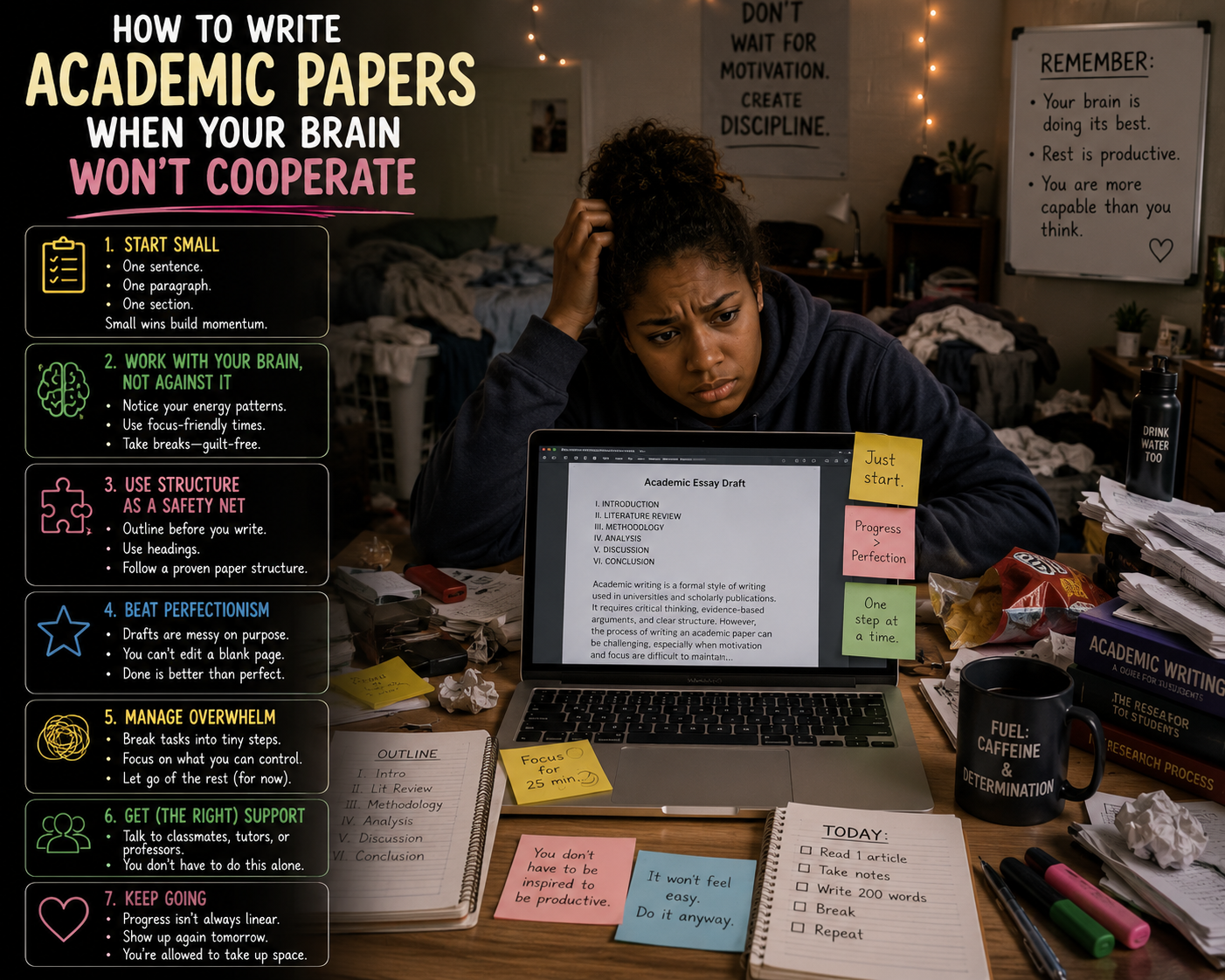
Standard writing advice was not designed for ADHD brains. Here's what actually works — not because it's the 'right' way to write, but because it works with how your attention genuinely operates.
And you've probably tried all of it. You set the timer. You broke it into tasks. You sat down to "just start." And forty-five minutes later you were deep in a Wikipedia rabbit hole about something completely unrelated to your paper.
Standard writing advice was not built for ADHD brains. It was built for people who experience writing difficulty as resistance that can be overcome with discipline. ADHD writing difficulty is different — it's not about resistance, it's about how attention and motivation work at a neurological level.
So here's what actually helps. Not because it follows the rules, but because it works with the way your brain actually operates.
Why Writing Is Specifically Hard With ADHD
Writing is hard for ADHD brains for a few overlapping reasons:
It lacks immediate feedback. ADHD brains are typically motivation-poor with tasks that don't produce immediate, clear reward signals. Writing a paragraph doesn't feel like progress. You can't tell if it's good until much later. That absence of feedback makes it very hard to stay engaged.
It requires holding multiple things in working memory at once. You're tracking your argument, your evidence, your source citations, your sentence structure, and whether you're staying on topic — simultaneously. Working memory is often one of the most impaired executive functions in ADHD.
It has no external structure. Sitting down to "write a paper" is one of the most open-ended tasks a human can be given. No defined steps. No clear checkpoints. No one telling you what to do next. ADHD brains often function much better with external structure than without it.
The hyperfocus problem works against you. You might get deeply engaged with one interesting aspect of your topic and spend four hours on that section, leaving nothing for everything else. Or you never hit hyperfocus at all and the whole thing stays impossible.
What Actually Helps
Talk before you type
One of the most effective strategies for ADHD writers — and one almost no one talks about — is voice-first drafting. Open a voice recorder, a phone app, or just turn on your computer's dictation feature, and talk through what you're trying to say.
Don't write. Talk. Explain your argument like you're telling someone. Then transcribe it, clean it up, and you have a draft.
Talking is genuinely easier for a lot of ADHD brains than typing. It's more active, more social, and it bypasses the "blank page" paralysis because you're not trying to produce polished text — you're just saying things.
You can use apps like Otter.ai or even just Google Docs voice typing. The transcript won't be pretty. That's fine. It'll have content, and content is everything at the draft stage.
Separate every stage
The reason "sit down and write the paper" doesn't work isn't that you can't write — it's that "write the paper" is actually twenty different tasks packed into one instruction.
Separate them completely and do only one at a time: - Research (just find and read sources — don't write anything) - Note-taking (just capture what you found — don't shape it) - Outlining (just structure the argument — don't write prose) - Drafting (just get words down — don't edit) - Editing (just fix things — don't generate new content)
When you're researching, you're only allowed to research. When you're drafting, you're not allowed to fix your citations. The cognitive switching between modes is what creates paralysis — so stop switching.
Use external accountability aggressively
ADHD brains often find that working in the presence of others makes task completion dramatically easier. This isn't laziness — it's body doubling, a well-documented phenomenon where the presence of another person creates enough ambient accountability to sustain attention.
Study rooms. Libraries. Coffee shops. Virtual coworking sessions on YouTube (search "pomodoro study with me" — there are thousands of hours of these). Discord study servers where you check in with what you're working on.
The other person doesn't have to be doing anything related to your work. They just have to be there.
Write in short sprints, but only when engaged
The standard advice is "write for 25 minutes, take a 5-minute break, repeat." This works for some people. For ADHD brains, it often doesn't, because the timer itself becomes a source of distraction and the 25-minute blocks are too short to enter any kind of flow.
Experiment with longer unstructured blocks when you hit engagement, and complete breaks rather than scheduled ones. If you're writing and something is actually clicking, don't stop for a scheduled break — stay with it. If it's not clicking, a break won't fix it; you probably need a different strategy or a different time of day.
Know your time of day
Most people with ADHD have a narrow window during the day when their executive function is most available. It's not always the morning. It might be late afternoon. It might be 10pm.
Figure out when your best window is and protect it ruthlessly for writing. Don't use that window for email, admin, or anything else. Use it for the thing that requires your sharpest attention.
Everything else can happen when you're in a lower-function period.
Lower the quality bar for drafts
Perfectionism is the enemy of ADHD productivity in a specific way: when the gap between "what I could write right now" and "what would be good enough" feels too large, the brain just... doesn't start.
Give yourself permission to write badly in the draft. Deliberately. Write placeholder sentences — "this is where I explain the methodology, I'll fix this later." Write messy transitions. Write sections out of order. Put in brackets where you need to find a citation: [CITATION NEEDED].
The draft doesn't have to be good. It has to exist. Editing a bad draft is infinitely easier than starting from zero, and the permission to be bad is sometimes all it takes to get started.
On Deadlines Specifically
ADHD often makes deadline pressure both more intense and less effective than it is for neurotypical people. On one hand, urgency can trigger motivation. On the other hand, extreme urgency can trigger paralysis.
If you're in that paralysis zone — deadline close, nothing written, completely stuck — don't white-knuckle through it alone. Ask for an extension if there's any chance of getting one. Get a friend to sit with you. Move to a different physical space. Work on the easiest possible section first just to break the standstill.
And if the deadline is truly immovable and the work is genuinely out of reach, professional writing help exists. It's not a moral failure to admit that you're in a situation you need help with. ADHD makes everything harder than the neurotypical world acknowledges, and getting through your degree by whatever legitimate means are available to you is a reasonable goal.
You're not behind because you're lazy. You're behind because you're running a different operating system in a world built for a different one. Act accordingly.
WriteProf Team
WriteProf expert contributor sharing insights on professional writing, career growth, and platform updates.