Why You Can't Start Writing (It's Not What You Think) and How to Finally Get Going
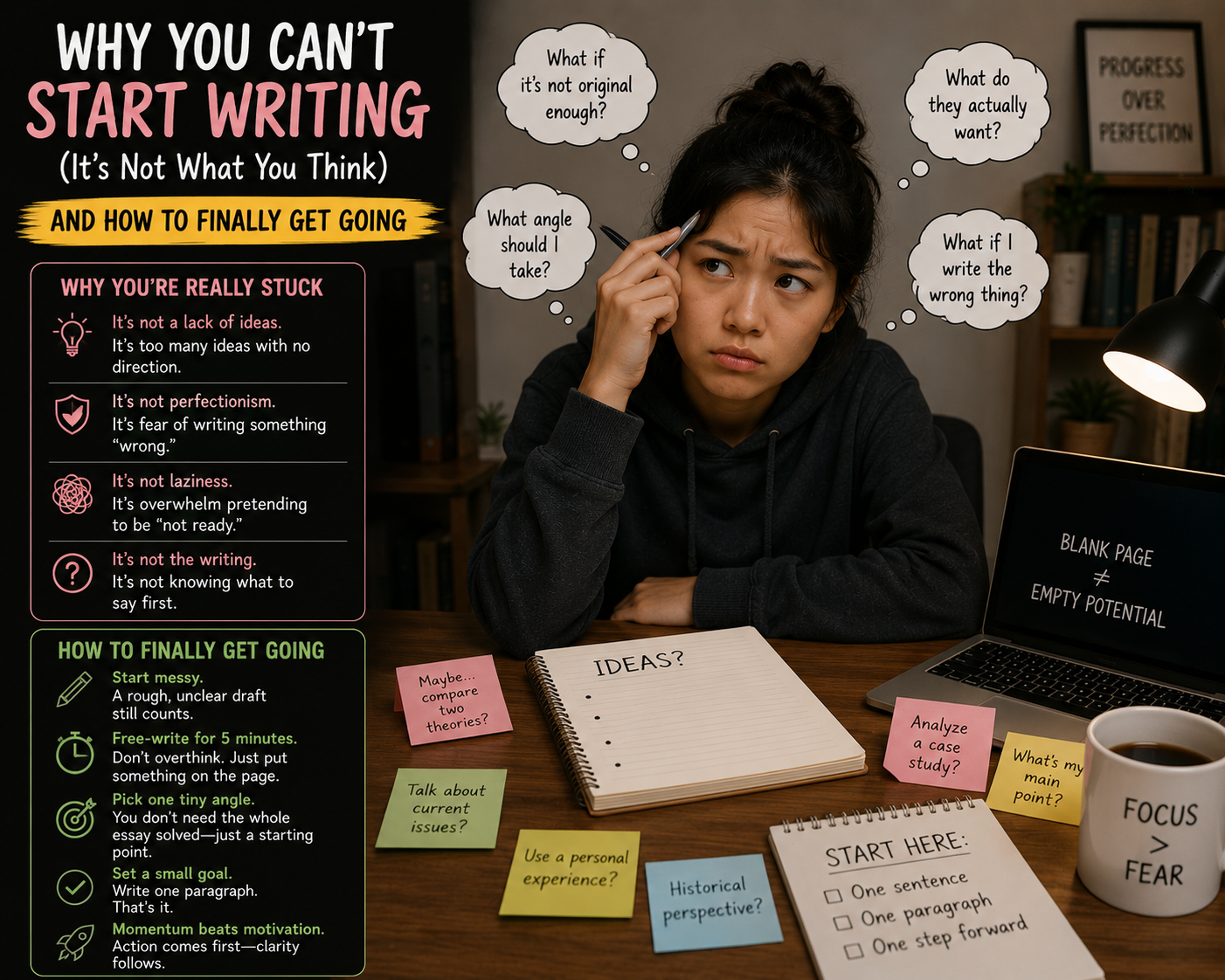
Procrastinating on writing isn't a time management problem. It's a psychological one. And once you understand what's actually happening, the fix is much simpler than you'd expect.
Research on procrastination says something more interesting: we avoid tasks primarily because of the emotions we associate with them, not because of poor planning.
When you put off writing, it's almost always because starting the paper triggers something uncomfortable — anxiety about whether it will be good enough, uncertainty about where to start, fear of confronting how little you actually understand the topic, or even a low-grade dread of sitting alone in a room with a blank document for hours.
Procrastination is emotional avoidance wearing the costume of bad time management.
That matters because it changes how you fix it. You can't fix an emotional response with a calendar app.
What's Actually Blocking You
There are a few distinct types of writing avoidance. Knowing which one you're dealing with helps:
Perfectionism block. You have a clear picture of what the finished paper should be, and what you could write right now falls so far short of that picture that you'd rather write nothing than write something bad. You're not avoiding the work — you're avoiding the gap between your standards and your current ability.
Clarity block. You're not sure what you're trying to say. You haven't figured out the argument yet, and writing feels impossible because you don't know what you're writing. This isn't procrastination in the usual sense — it's a signal that you need more thinking before you need more writing.
Overwhelm block. The task feels too large to begin. "Write a 5,000-word essay" is not a task — it's a project. When the whole thing is present in your mind at once, the mind recoils.
Environment block. You've associated certain environments (your desk, your room, the library) with distraction or with previous unsuccessful attempts, and showing up there doesn't put you in a writing state. It puts you in the state you were in last time — which was probably anxious and unproductive.
What Actually Works
For perfectionism block: give yourself permission to be terrible
The best writing advice I've ever encountered is so simple it sounds dismissive: lower the quality bar for the draft.
Tell yourself, explicitly, that the draft is allowed to be bad. Not "I'll try to do my best but won't stress about it." Actually say: this draft is for me to figure out what I think, not for anyone to read. It's allowed to be incoherent, unfinished, and wrong.
Then write. Fix it later.
This works because perfectionism block is created by the gap between standards and current output. Temporarily lower your standards (for the draft only) and the gap closes. The resistance drops.
For clarity block: write to think, not to produce
If you don't know what you're arguing, writing an essay won't help. But writing something else might.
Write yourself a memo. What do I think the answer to this question is? What am I unsure about? What would I need to know to be more confident? What's the most interesting tension in the material I've read?
This is exploratory writing — it's not the paper, it has no structure, no one will read it, it doesn't count. Its only job is to help you think. Many writers who feel blocked are actually stuck because they went to the "producing" mode before they'd done enough "thinking" mode.
For overwhelm block: work on one sentence
"Write 2,000 words" is an impossible instruction. "Write the first sentence of the second body paragraph" is not.
Break it down to the smallest possible unit of work and do only that. Then do the next smallest unit. You won't feel momentum at the start. Momentum is a product of having written something — not a precondition for it.
Some people find that having a detailed outline helps with overwhelm because it converts one large task into twenty smaller ones. Others find that outlines create their own kind of overwhelm (now I have to fill all these boxes). Know which type you are.
For environment block: change the location
This is the most practically underestimated writing advice. If you're not writing at your desk, don't try to write at your desk.
Go somewhere you've never worked before. A cafe you haven't tried. A different floor of the library. A park bench with a notebook. A completely new environment doesn't carry the accumulated associations of previous failed attempts, so the resistance is lower from the start.
Novelty in environment is genuinely useful for breaking a stuck state.
The Deadline Trap
Here's something worth being honest about: urgency does help some people start. The anxiety of "this is due in four hours" is sometimes the only thing that overrides the anxiety of "what if it's not good enough."
The problem is that by the time urgency kicks in, you often don't have the time to write something you're actually happy with. You write something adequate. It meets the requirement. But it doesn't represent what you could have done.
That's fine sometimes. But if you're consistently producing adequate work at the last minute when you're capable of better, the block deserves more direct attention than deadline panic.
When You've Already Hit the Wall
If you're reading this because you have a deadline today or tomorrow and you still haven't started: none of the above changes your immediate situation. What changes your immediate situation is starting something — anything — in the next ten minutes.
Open a document. Write a terrible first paragraph. Keep going. Don't stop to revise until you have something on the page.
If the deadline is genuinely immovable and you're further behind than a sprint can fix, your options are narrower: ask for an extension, submit what you have, or get professional help.
All of those are real options. None of them is a moral failure. They're just different responses to the same problem: you have work that needs to exist by a specific time, and right now it doesn't.
Pick one and act on it. The worst thing you can do is spend the next two hours neither writing nor asking for help.
WriteProf Team
WriteProf expert contributor sharing insights on professional writing, career growth, and platform updates.